
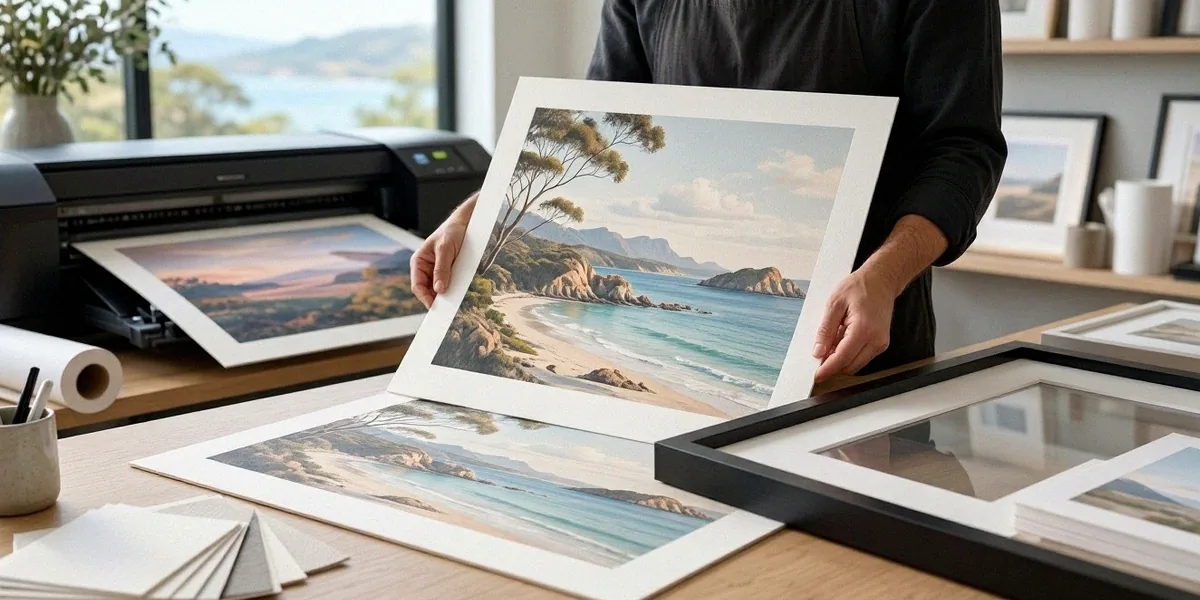
Printing Digital Art in Australia: Papers, Inks and Framing
You’ve just bought a digital artwork you love, or maybe you’ve spent weeks creating your own pixel art masterpiece, and now you want it on your wall. You open a browser, search for print services, and suddenly you’re drowning in options: giclée, cotton rag, archival pigment, fine art paper, canvas wraps, framed or unframed. The prices swing wildly, the terminology feels like a foreign language, and every site claims to be “museum quality.” We’ve been through this ourselves, and we’ve watched plenty of Australian collectors get burned by cheap prints that fade or warp within a year. This guide cuts through the noise and explains exactly what to look for when printing digital art in Australia.
Why Printing Digital Art in Australia Is Different
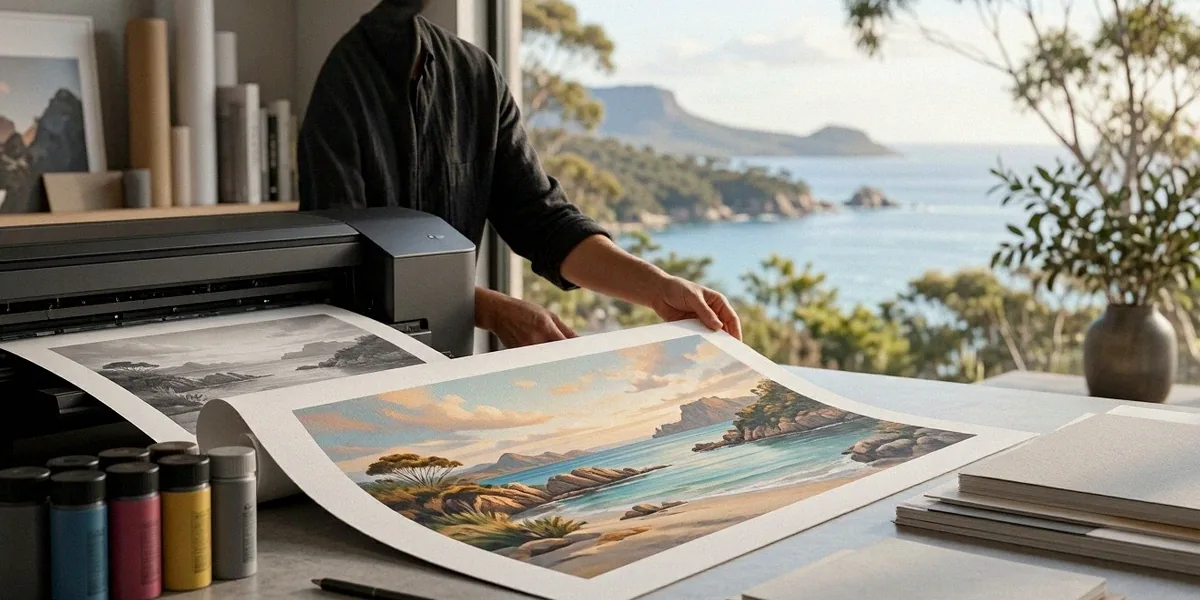
Australia’s climate is brutal on printed artwork. Between the humidity of Queensland summers, the relentless UV of Western Australia, and the temperature swings in Melbourne, a print that survives beautifully in a London flat might degrade fast in a Sydney apartment. Local print labs like Printspace and Atkins Technicolour understand these conditions because they deal with them daily, and they’ll steer you toward materials that handle Australian light and moisture rather than idealised European conditions.
Humidity and Paper Warping
Paper is hygroscopic, meaning it absorbs and releases moisture from the air. In high humidity, cheaper papers swell, cockle, and warp inside a frame. Once that happens, no amount of flattening fully fixes it. Cotton rag papers handle humidity swings far better than budget photo papers because their fibre structure is more stable, which is why we always recommend them for Queensland and coastal New South Wales.
UV Exposure and Ink Fading
Australia has some of the highest UV levels on earth. Dye-based inks can visibly fade in a sunlit room within a couple of years, while pigment inks paired with UV-blocking glazing can hold up for decades. If your print is going anywhere near a window, both your ink choice and your glazing matter enormously.
Choosing the Right Paper for Digital Art
Paper is the single biggest factor in how your print looks and how long it lasts. The three main categories are cotton rag, alpha cellulose, and standard photo papers, and each behaves differently under Australian conditions. Brands like Canson Infinity and Hahnemühle dominate the fine art market, and you can source them through Australian suppliers such as Photo Continental.
Cotton Rag vs. Alpha Cellulose
Cotton rag papers are made from 100% cotton fibre, contain no lignin, and are naturally acid-free. They’re the gold standard for archival digital art prints. Alpha cellulose papers are refined wood pulp that’s chemically treated to remove lignin, making them a solid mid-range option. They’re cheaper than cotton rag but still archival if the manufacturer says so. Standard photo papers are coated resin sheets, fine for casual display but not built for decades on an Australian wall.
Textured vs. Smooth Surfaces
Textured papers like Hahnemühle German Etching add a tactile, painterly quality that suits generative art and illustration. Smooth papers like Canson Infinity Baryta Prestige give razor-sharp detail, which pixel art and crisp vector work often need. There’s no universal right answer, but we suggest ordering a sample pack before committing to a large print run.
Weight and Thickness Considerations
Fine art papers typically range from 200gsm to 310gsm. Heavier papers feel more substantial, resist cockling better, and frame more cleanly. For anything larger than A3, we recommend nothing lighter than 250gsm.
Inks That Last: Pigment vs. Dye
Pigment inks use microscopic solid particles suspended in a carrier, while dye inks use colour dissolved in liquid. Pigment particles sit on the paper surface and resist UV and moisture far better. Epson UltraChrome and Canon Lucia Pro are the two dominant pigment ink systems, and most serious Australian labs run one of them. If a print service can’t tell you which ink system they use, that’s a warning sign.
Archival Ratings and Testing
Wilhelm Imaging Research publishes independent longevity ratings for ink and paper combinations. A well-matched pigment ink and cotton rag paper can rate over 100 years under glass. Dye prints on cheap paper might rate under 20. Ask your lab for the specific Wilhelm rating of their ink-paper combo.
Print Permanence in Australian Conditions
Those ratings assume reasonable display conditions. In a sun-drenched Australian living room, expect real-world lifespans to be shorter unless you use UV glazing and keep the print out of direct sun. Pigment inks still win by a wide margin.
Framing and Display Options Down Under
Framing is where a lot of collectors cut corners and regret it. Australian framers like Framing Online and FrameCo offer both conservation and decorative options, and the difference matters if you care about longevity.
Conservation vs. Decorative Framing
Conservation framing uses acid-free mat boards, archival mounting, and reversible techniques so the artwork isn’t damaged. Decorative framing prioritises looks and cost, often using acidic mats that yellow and stain the print over time. For anything you’ve spent real money on, go conservation.
UV-Blocking Glass and Acrylic
Museum glass blocks around 99% of UV and reduces glare. Acrylic options like Optium are lighter and safer for large pieces. Both cost more than standard glass, but they’re the difference between a print that lasts and one that fades.
DIY Framing Kits in Australia
If you’re framing on a budget, Australian suppliers sell acid-free backing boards and UV acrylic cut to size. Just avoid cheap MDF backing, which off-gasses and damages prints.
Red Flags: From Cheap Prints to NFT Scams
Not every deal is a good one, and some are outright frauds. We’ve seen too many collectors lose money to both shoddy print shops and elaborate NFT schemes.
Spotting Low-Quality Print Services
- Prices dramatically below market rate for “giclée” prints
- No mention of specific paper brands or ink systems
- Stock photos of “their” studio that reverse-image search reveals elsewhere
- No physical Australian address or ABN
- Reviews that all appear within the same week
NFT Scams That Promise Physical Prints
A common NFT scam involves selling a digital token with the promise of a limited-edition physical print that never ships, or ships as a cheap poster. Scammers exploit the hype around digital collectibles to move money fast. If you’ve been targeted, report it to ACCC Scamwatch, which tracks these schemes and shares intelligence with other agencies.
Our Recommended Printing Workflow
Here’s the process we follow for every print we care about.
Preparing Your Files
Export at 300dpi at final print size, use a wide-gamut colour space like Adobe RGB or ProPhoto RGB, and embed your ICC profile. Soft-proof against your chosen paper’s profile before sending.
Working with Local Labs
Sydney’s The Print Bar and Melbourne’s Image Science are two we trust for quality checks and colour accuracy. Local labs let you inspect proofs in person, which beats guessing from a screen.
Proofing and Final Adjustments
Always order a small proof print before a large run. Compare it to your screen under neutral light, adjust brightness and contrast if needed, then commit to the final print and frame.
FAQ
How much should I expect to pay for a fine art print in Australia?
For an A3 pigment print on cotton rag, expect roughly $40 to $90 depending on the lab and paper. Framing with UV glazing typically adds $150 to $400.
Can I print digital art at home and still get archival quality?
Yes, if you use a pigment-based printer like an Epson SureColor P-series or Canon imagePROGRAF with genuine pigment inks and quality cotton rag paper. Dye-based home printers won’t last.
Is cotton rag really worth the extra cost?
For anything you plan to keep or display long-term in Australia, yes. The humidity and UV resistance alone justifies the price difference.
How do I report an NFT or print scam in Australia?
Report it to ACCC Scamwatch via scamwatch.gov.au. If money was transferred, also contact your bank and ReportCyber.
Do I need UV glass if my print isn’t near a window?
It’s still worth it. Indirect UV and indoor lighting degrade prints over years, and UV glazing slows that dramatically.
Investing in quality paper, pigment inks, and proper framing is what turns a digital file into a piece you can hand down. Australia’s climate makes those choices more important, not less. And whether you’re buying prints or digital collectibles, stay sharp: if a deal looks too good to be true, it usually is. Check the lab, check the paper, and report anything suspicious to ACCC Scamwatch.