
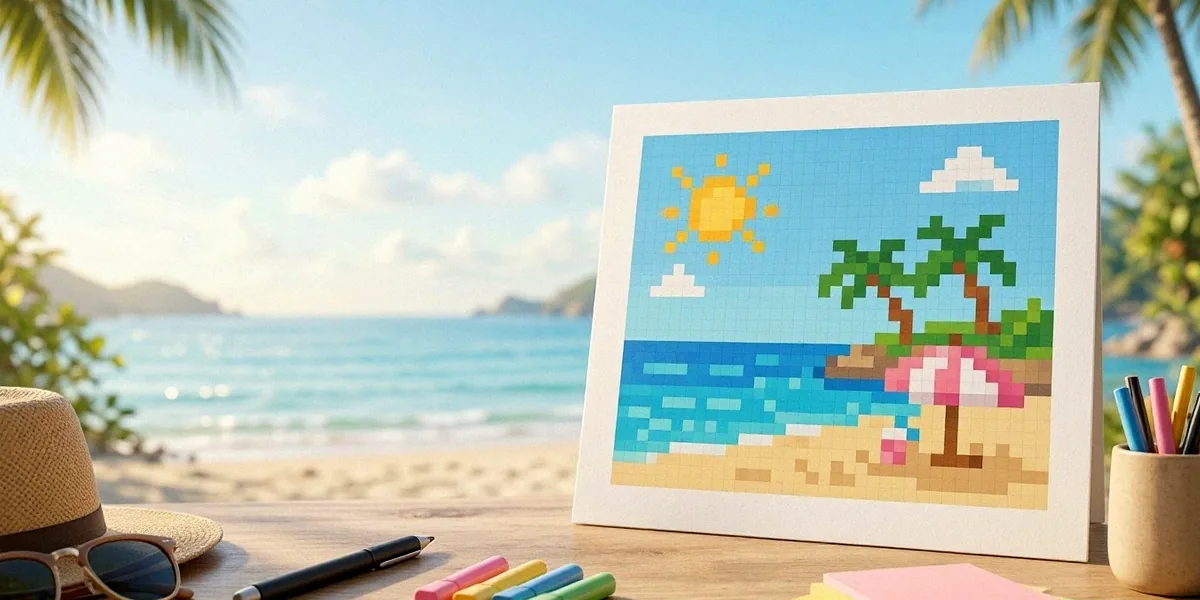
Summer Pixel Art Challenge: Drawing Prompts for the Holidays
As the Australian summer heats up, we’re launching a pixel art challenge to keep you creative indoors during the holidays. Whether you’re escaping a 40-degree day in Sydney or hiding from the flies in Melbourne, there’s nothing better than parking yourself in front of an air conditioner with a cold drink and a canvas of tiny squares. Over four weeks, we’ll be posting daily prompts inspired by everything we love about an Aussie summer — the beach, the bush, the backyard BBQ, and the fireworks that ring in the New Year. Grab your tablet or laptop, pick a tool, and join us. This is your chance to build skills, share work with the local community, and maybe even turn your creations into collectible cards.
Why a Summer Pixel Art Challenge?
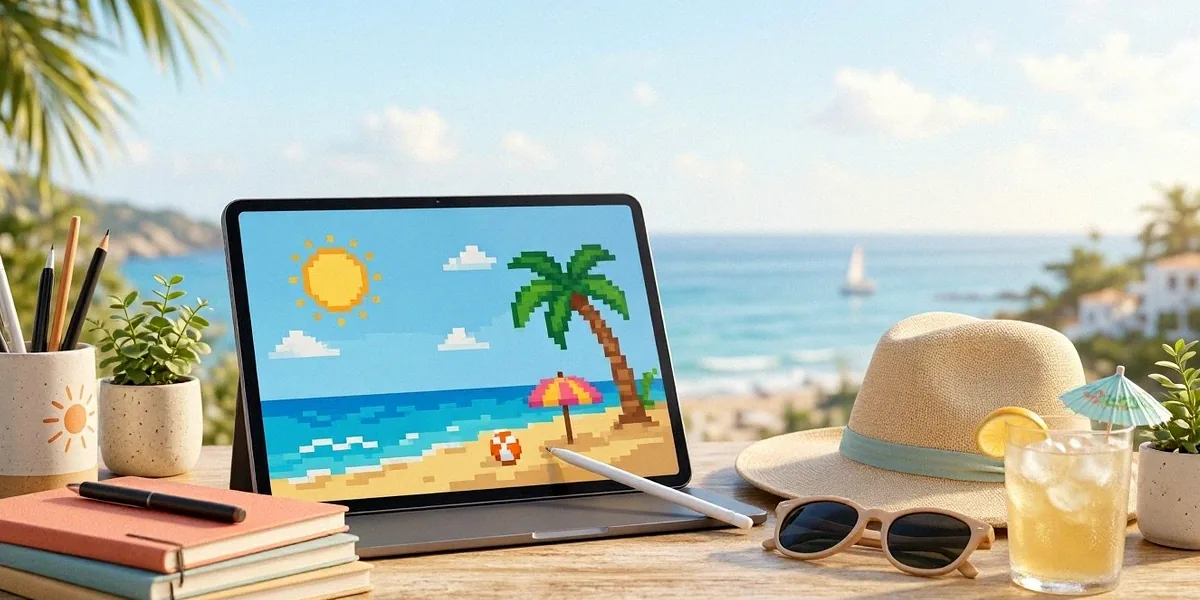
We started this challenge because the Australian summer holidays are long, hot, and often a bit unstructured. Christmas and New Year fall right in the middle of it, which means plenty of downtime between family lunches and beach trips. Pixel art fits that rhythm perfectly — you can knock out a small sprite in twenty minutes or spend an afternoon refining a scene. It’s also one of the most accessible entry points into the broader world of digital art Australia has to offer.
Beat the heat with indoor creativity
When the mercury climbs past 38°C, outdoor plans get cancelled fast. Rather than scrolling aimlessly, we’d rather see you making something. Pixel art is quiet, low-energy, and portable — you can work on a phone, a tablet, or a laptop while the fan hums in the background. It’s also a great way to keep kids occupied during the school holidays without parking them in front of a streaming service for six hours.
Pixel art’s low barrier to entry
You don’t need a $3,000 drawing tablet or a fine arts degree. Free tools like Piskel run in a browser, and Aseprite is affordable and packed with features once you’re ready to level up. A 32×32 canvas is enough to make something recognisable, and the constraints actually help beginners — you can’t overthink a sprite that’s only got 1,024 pixels to work with.
From pixels to collectible cards
Pixel art has a natural connection to collectible cards. The aesthetic borrows from 8-bit and 16-bit era game art, which is exactly the look that trading cards and sticker albums traded on for decades. Once you’ve got a set of sprites, printing them as physical collectible cards is a genuinely fun project. We should also flag the cautionary side of the digital art boom: the rise of generative art has been exciting, but NFT scams have burned a lot of Australian creators and buyers. Treat any “mint your art for guaranteed profit” pitch with heavy scepticism.
How the Challenge Works
The rules are simple. We post a prompt each day for 28 days, you make a piece of pixel art that responds to it, and you share it with the hashtag #PhockheadsSummer. You can do every prompt or just the ones that spark something. There’s no entry fee, no judging panel, and no gatekeeping — this is about building a habit and having fun with the community.
Daily prompts and themes
Each day’s prompt is a single word or short phrase, with a suggested canvas size and an optional technique challenge. Prompts are grouped into weekly themes so you can see the arc: beach and surf in week one, bush and wildlife in week two, backyard BBQ in week three, and New Year’s fireworks in week four. We’ll post the full list at the start of each week so you can plan ahead.
Sharing your work and tagging
Post your art on Instagram, TikTok, or X with #PhockheadsSummer so we can find it. Instagram is where most of the Australian pixel art community hangs out, and it’s the easiest platform for us to reshare from. We also run a local Discord where you can drop work-in-progress shots, ask for feedback, and swap palette ideas. If you’re in a regional area, the Discord is often the closest thing to a studio group you’ll find.
Weekly community showcases
Every Sunday evening we compile a showcase of our favourite submissions from the week and publish it on the blog. We try to feature a mix of beginners and experienced artists, and we always credit the creator with a link back to their profile. Getting featured isn’t a competition — it’s just a way to say thanks for participating and to give people something to scroll through on a Monday morning.
Holiday Drawing Prompts: Week by Week
Here’s how the four weeks break down. Each week has a theme, a set of daily prompts, and a suggested pixel art technique to practise. You can adapt any prompt to your own style — a beach scene can be a single surfboard or a full panorama.
Week 1: Beach and surf
We kick off with the classic Australian summer setting. Prompts include things like a surfboard, an esky, a beach umbrella, a seagull stealing chips, a rock pool, and a sunburnt tourist. The technique focus is colour palettes — specifically how to render sand, water, and sky without making everything look flat. Try limiting yourself to eight colours and see how much depth you can squeeze out of them.
Week 2: Aussie bush and wildlife
Week two heads inland. Prompts cover a kookaburra, a kangaroo, a gum tree, a cockatoo, a wombat, and a bush track at dusk. The technique focus is silhouette and shape — wildlife sprites live or die on whether the outline reads clearly at small sizes. This is also a great week to practise dithering, which is the pixel art trick of alternating two colours to fake a third.
Week 3: Backyard BBQ and mates
Week three is about people and props. Prompts include a snag on the barbie, a stubby holder, a folding chair, a cricket set, a fly screen door, and a mate mid-argument about whether tomato sauce belongs on a sausage. The technique focus is character design at small scale — how to give a 16×16 sprite a personality with two or three pixels of expression.
Week 4: New Year’s fireworks and celebrations
The final week builds towards New Year’s Eve. Prompts include fireworks over a harbour, a countdown clock, sparklers, a party hat, and a midnight toast. The technique focus is animation — looping a firework burst or a sparkler flicker is a great way to finish the challenge with something that moves. Once you’ve got an animated sprite, you’ve got a strong candidate for a collectible card design.
Tools and Tips for Pixel Art Beginners
You don’t need much to start, but the right tool makes a difference. Here’s what we recommend, plus a few tips we’ve picked up from running these challenges.
Free and paid pixel art software
- Piskel — free, browser-based, no install required. Perfect for testing whether you enjoy pixel art before committing to anything.
- Aseprite — paid, around $30 AUD, and the industry standard for a reason. Excellent animation timeline, onion skinning, and palette management.
- LibreSprite — a free open-source fork of Aseprite if you want the same workflow without paying.
- Pixquare — a solid iPad option if you prefer drawing with a stylus.
Colour palettes for summer vibes
Australian summer has a distinct palette: bleached sand, hard blue sky, eucalyptus green, and the orange-pink of a late afternoon. We recommend starting with a limited palette of 8 to 16 colours and building from there. Sites like Lospec host thousands of free palettes you can import directly into Aseprite. Resist the urge to use every colour available — restraint is what makes pixel art read cleanly.
Animating your pixel art
Animation is where pixel art gets really fun. Start with a two-frame loop — a blink, a flicker, a wave — and build up from there. Keep your frame counts low (four to eight frames is plenty for most sprites) and focus on clear silhouettes. If you’re planning to print your work as collectible cards, animated sprites also make great lenticular or foil-stamped designs.
One more warning while we’re on tools: if a platform promises to mint your pixel art as an NFT and guarantee resale value, walk away. NFT scams are common in the digital art space, and Australian creators have lost real money to fake marketplaces and rug-pull projects. Stick to reputable platforms and never pay upfront fees for “guaranteed exposure”.
Showcasing and Collecting Your Work
Finishing the challenge is one thing — doing something with the art is another. Here’s how we like to wrap up a month of pixel art.
Printing your pixel art as cards
Collectible cards can be printed from pixel art designs with surprisingly little effort. Services like Moo, VistaPrint, and local Australian print shops will produce small runs of trading cards from your files. Upscale your sprites to at least 300 DPI before printing, and consider a matte finish — it hides the pixel grid better than gloss. A set of 10 to 20 cards makes a great gift or a swap item at meetups.
Local Australian art meetups
Local Australian art meetups often happen in cities like Sydney and Melbourne, and they’re a great place to trade cards, compare tools, and meet other pixel artists in person. Sydney has regular zine and indie game dev meetups, and Melbourne’s laneway gallery scene often hosts digital art nights. Brisbane, Perth, and Adelaide have smaller but growing communities — check local Discord servers and Facebook groups for dates.
Staying safe from NFT scams
If you do decide to explore blockchain-based collectibles, be careful. NFT scams typically involve fake marketplaces, phishing links sent via DM, and “collab” requests that ask you to connect your wallet to a malicious site. Never share your seed phrase, never sign a contract you don’t understand, and never pay a fee to “unlock” a sale. The technology itself isn’t the problem — the predators around it are.
FAQ
Do I need to be good at drawing to join the challenge?
Not at all. Pixel art is forgiving because the canvas is tiny and the rules are simple. Most people improve dramatically within the first week just by showing up daily. Our showcases always include beginner work.
What size canvas should I use?
For daily prompts, 32×32 or 64×64 is ideal. It’s big enough to include detail but small enough to finish in a single sitting. If you want to print your work as a collectible card later, you can always recreate it at a larger size.
Is Piskel or Aseprite better for beginners?
Start with Piskel if you’ve never made pixel art before — it’s free and runs in a browser. Move to Aseprite once you want animation tools, palette management, and a proper export pipeline. Both are popular for good reason.
Can I sell the pixel art I make during the challenge?
Yes, you own your work. You can print it as collectible cards, sell prints, or use it in games. Just be cautious about any platform that asks for upfront fees or promises guaranteed returns — that’s a common pattern in NFT scams.
Where can I find other Australian pixel artists?
Instagram and Discord are the two biggest hubs. Search #PhockheadsSummer and #pixelartAustralia on Instagram, and look for local Discord servers tied to Sydney and Melbourne indie game dev communities. Local art meetups in those cities are also worth attending in person.
We hope you’ll join us for the Summer Pixel Art Challenge. Four weeks, 28 prompts, and a whole lot of tiny squares — it’s the perfect way to spend the holidays indoors while the sun does its worst outside. Share your work with #PhockheadsSummer, drop into the Discord, and keep an eye on the weekly showcases. Whether you’re a first-timer or a seasoned pixel pusher, there’s a place for you in this community. Happy holidays, and happy pixelling.